Eutectic Solidification of Gray Cast Iron. PartIII
By:Cees van de Velde
Last revision: January 15, 2004
The mechanism of Eutectic Cell formation in gray cast iron, as proposed in the early sixties appeared to be very simple and suitable to explain the majority of events that take place during solidification of flake graphite irons.
Soon, however, this simple mechanism would show many shortcomings.
Subdivision of eutectic cells.
First of all, hardly any uniform shape of eutectic cells appeared to exist.
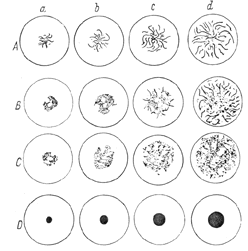
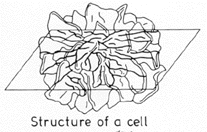
Pelhan (55,56,57) was able to divide eutectic cell formation into four basic types. In his system, the combination of a graphite nodule and surrounding austenite halo was also regarded as a "eutectic cell".
This is presented in figure 1.
Gunnarson (58) is of the opinion that eutectic cells in gray cast iron can be subdivided into three types:
Type 1 , containing A graphite in radial formation,
Type 2, containing D-graphite in the center, A-graphite at the circumference,
Type 3, containing only type D (undercooled) graphite.
For all different types, a different formation mechanisnm is supposed to exist, depending on the amount of undercooling.
Extreme deviations in Cell Count
Although a clear relationship was supposed to exist, between the number of eutectic cells per area and cooling velocity, in many cases the opposite was actually found.
Under fast cooling conditions many and small Eutectic Cells can be found (which might be expected), but also few and very large EC (21,22,23).
In the center of slowly cooling parts, spots with an extremely high cell count can be found (ten-fold of the average cell count)(21,22,23).
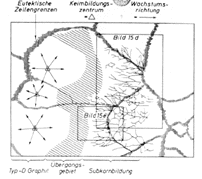
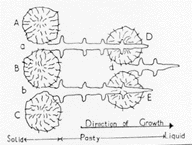
Lux(59,60) explains this fenomenon by assuming that in the ahead of the solidification front, a strong supercooling occurs in the liquid ( constitutional supercooling).
Figure 2.Formation of sub-cells due to constitutional undercooling.
Recent research work (61) showed that apart from undercooling towards the end of solidification, other factors such as the shape and type of the sand mold as well as the casting temperature play an important role in the formation of secondary cells.
Non-cellular growth
Although it has been assumed that different types of Eutectic Cells exist,
it was surprising to find out that not in all circumstances formation of eutectic cells takes place!
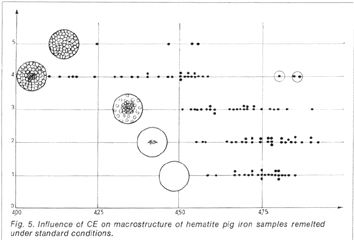
Parent-Margerie (62)established the fact that the presence of eutectic cells is strongly dependant of the carbon-equivalent of the material involved. After comparison of structures of a large numer of pig irons, these researchers were able to make a qualification ranging from 1 (no eutectic cells) through 5 (regular shaped eutectic cells). Figure 3 represents this division.
From this figure it appears that especially in the hypereutectic region, formation of eutectic cells does not take place. It is assumed that primary graphite surpresses the formation of eutectic cells.
Exeptions, however, remained, which meant that apart from the influence of carbon equivalent, still other influences must exist. Reason why Das and Motz (63) made similar tests on slow cooling cast iron parts. They also noticed a gradual transition from cellular to non-cellular, depending on carbon equivalent. Also superheating temperature, inoculation and/or increase of silicon content influence this transition.
The formation of eutectic cells is not only surpressed at the hypereutectic side. At the other end, representing strongly hypo-eutectic compositions, the formation of eutectic cells is also surpressed. At low carbon concentrations, no EC are found any more (63,64). It is assumed that the formation of primary austenite dendrites prevent cell formation.
Formation of Eutectic Cells
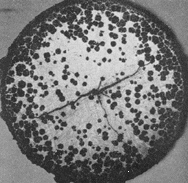
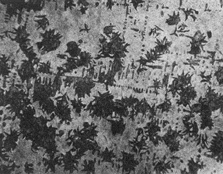
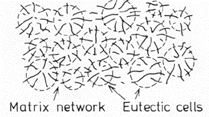
A general idea has been accepted that eutectic cells form freely in the liquid, somewhat ahead of the solidification front. This starting point for instance is used in solidification simulation programms. The macro image of fig.4 is the reason for this attitude. Figure 4. Formation of eutectic cells during solidification. According to Hughes. Note that between many of the Eutectic Cells some directional relationships appear to exist. Many adjacent cells can be connected with a curved or straight line.
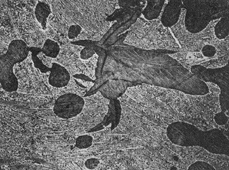
According to Lakeland (66), rapid growth of austenite dendrites initiates eutectic cell formation and controlls the position of eutectic cells relative to the austenite dendrites. Figure 5 Formation of eutectic cells initiated by austenite dendrites, according to Lakeland.
Das en Motz (63) however, noticed a completely different mechanism in the transition zone cellular/non-cellular. According to the authors, the formation of new eutectic cells take place by renewed branching of graphite flakes that are still in contact with the liquid.
In pure iron-carbon alloys (67) it appears that eutectic cells form from existing primary austenite dendrites at low carbon percentages. As shown in fig.6 and 7.
In this concept, a eutectic cell forms an integral part of the primary austenite phase.
With increasing carbon content, relationship with primary austenites become less and less clear and approaches the seemingly independant growth of fig.4.
Fig.6 and 7 Eutectic cells forming integral part of primary austenite dendrites.
Problems in measuring cell count.
Based on the fact that no good relationship between mechanical properties and cell count exists, it was shown that the usual Stead agent does not reveal eutectic cells in all circumstances (68). A new color etching method gave different results.
Difficulties can also be encountered when cell boundaries are not well revealed. (69)
Present day's application of Eutectic Cells
Today, the traditional concept of eutectic cell formation is still in use on different fields:
-As an additional method to controlling metal quality (70).
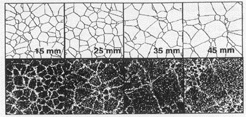
-In software to calculating mechanical stresses.
Figure 8 and 9 .
-A major application is found, however, in solidification simulation software (71,72,73).
Figure 10, actual cell counts as compared to calculated cell counts (acc. to 73).
Concluding remarks.
The concept of Eutectic Cell formation in gray cast iron has been developed forty years ago and is still generally accepted today.
When the available research work on this field is re-studied however, it turns out that EC in gray cast iron are in fact formed in a rather limited range of compositions (which happen to be the most usually ones in practice!).
Various views as to how EC actually form exist, ranging from a completely independ formation to a mechanism being an integral part of the primary phase.
The many uncertain facts, however, that still exists, leave enough room for a different approach of the solidification mechanism of gray cast iron, exactly as it turned out to be possible for the solidification mechanism of ductile cast iron.
References
(55)Einfluss einiger Elemente auf die Entwicklung der eutektische Zelle,
C.Pelhan, Giesserei-Praxis 1962, pp.183-89.
(56) Die Entwicklung des eutektischen Graphits im Gusseisen.
C.Pelhan,Giesserei-Praxis, 1963, pp. 95-100.
(57) Die Graphitform im Gußeisen.
G.Pelhan,Giesserei-Praxis, 1967, pp. 345-51.
(58) A proposal for the structure classification of grey iron.
S.Gunnarson,The British Foundryman, Vol.61 (1968), pp.279-90.
(59) Konstitutionelle Unterkühlung und Bildung eutektischer Subkorner in Fe-C-Si-Legierungen mit Lamellengraphit.
B.Lux,Giesserei technisch wissensch. Beihefte, Vol.18 (1966), pp. 219-29.
(60) Subgrain formation in Fe-C-Si alloys due to constitutional Undercooling.
B.Lux,AFS Cast Metals Research Journal, Vol.3 (1967), pp. 90-94.
(61) Secondary Nucleation of Eutectic Graphite grains,
E.Fras, W.Kapturkiewicz, A.A.Burbielko, H.F.Lopez.
AFS Transactions, 1996, pp.1-4
(62) Etude des fontes hématites par un essai de seconde fusion.
Parent,MargerieFonderie 1968, pp. 61-76.
(63-62) Über die nichtzellulare Kristallisation von Gußeisen mit Lamellengraphit.
R.N.Das, J.Motz,Giessereiforschung, Vol.24 (1972), pp. 171-84.
(64) The Fe-C transformation diagram related to solidification of cast irons.
R.W.Heine, AFS Transactions, Vol.78 (1970) pp. 187-93.
(65) Relationship of gray iron macro- and microstructures to cooling curves.
L.E.Menawati, R.W.Heine, C.R.Loper,Jr.,AFS Transactions, Vol.78 (1970), pp. 363-73.
(66)Directional solidification of Fe-C eutectic alloys containing various percentages of sulfur.
K.D.Lakeland, AFS Cast metals Research Journal 1966, pp.78-86.
(67) Formation of undercooled graphit in cast iron.
I.Igarashi, G.Ohira, K.Ikawa, T.Horigome, AFS Transactions, Vol.66 (1958), pp. 561-68.
(68)Eutectic solidification characteristic of commercial grey cast iron.
Wang Yiqing,Fan Zhikang,Gan Yu,Zhu Xianhua, Conference Proceedings, Cast Iron IV, 1990, Materials Research Society.
(69)Untersuchungen uber den Einfluss des Sauerstoffs nach Menge und Bindungsform auf die Eigenschaften von Gusseisen mit Lamellengraphit.
K.Lohberg,W.Weis, Giesserei, techn.wiss. Beihefte, Vol.16 (1964), pp.15-34.
(70)Durch beherrschte Schmelztechnik zur reproduzierbaren Qualitat von Gussteilen,
K-H Caspers, Giesserei, Vol.84 (1997), pp.11-16.
(71)An Experimental and Simulation Study of the Nucleation and Eutectic Cell Count in Lamellar Graphite Cast Iron,
F.Mampaey,World Foundry Congress 1988,Moskow, Paper no.2
(72)Modelling nucleation in lamellar and spheroidal graphite cast iron,
F.Mampaey, 58e World Foundry Congress,1991, Krakow, Paper no.21.
(73)Beitrag zur Modellierung der Abkuhlung und Kristallisation eutektischer Gusseisenlegierungen mit Lamellengraphit,
B.Leube,R.Mai, Giessereiforschung, Vol.49 (1997), pp.97-105.
(74)Accurate Evaluation of thr Mechanical Properties of Grey Cast Iron,
T.Noguchi, K.Shimizu, Cast Metals, Vol. 6 (1993),pp.146-51.